Opposing-Force & Red-Team Services — Train Against a Threat That Behaves Like the Real One
We play the drone threat, play the ground infiltration threat, and instruct your people in the detection and employment skills the threat demands. Under written authorization, published rules of engagement and a safety plan that aggressor realism never crosses.
The problem
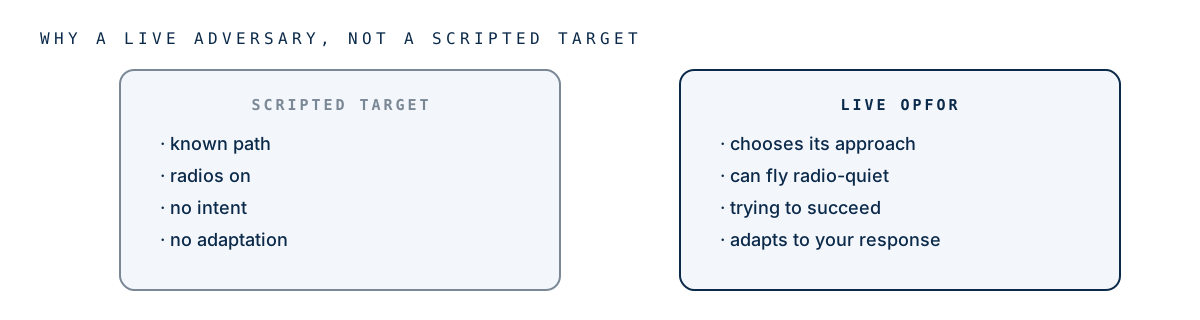
Small unmanned aircraft are a routine threat, and the training establishment has not kept pace. Soldiers and security teams need repeated, realistic practice at detecting, reporting and responding to small drones, and at using their own aircraft for overwatch and force protection. That requires an opposing force that behaves like the real threat. A scripted target does not.
A scripted target follows a known path with its radios on. A live adversary chooses, goes quiet, and adapts.
Three lines of effort
1. Live opposing-force training, available now
We play the threat and train the response. In the aerial mode we fly realistic adversary profiles against a facility or perimeter while your people practice detection, identification, reporting and response. In the ground mode our personnel act as infiltrators attempting to breach a perimeter with no drone involved, and the objective becomes your own use of organic aircraft for overwatch and force protection. We help you build the detection-and-report procedures that turn one observation into a coordinated response.
2. Counter-UAS system red-team assessment, available now
We assess a fielded detection system against the realistic threat and deliver a written vulnerability assessment with prioritized recommendations. Much detection leans on radio frequency; a drone flying a pre-planned mission with its radios quiet gives such a system very little to hear. See counter-UAS readiness for the facility-owner version.
3. Instrumented engagement training, in development
A low-cost instrumented adversary drone that registers laser-engagement hits, so units can run scored force-on-force counter-drone engagements without live fire. Offered as a developing capability, not a fielded product. Details.
How an event runs
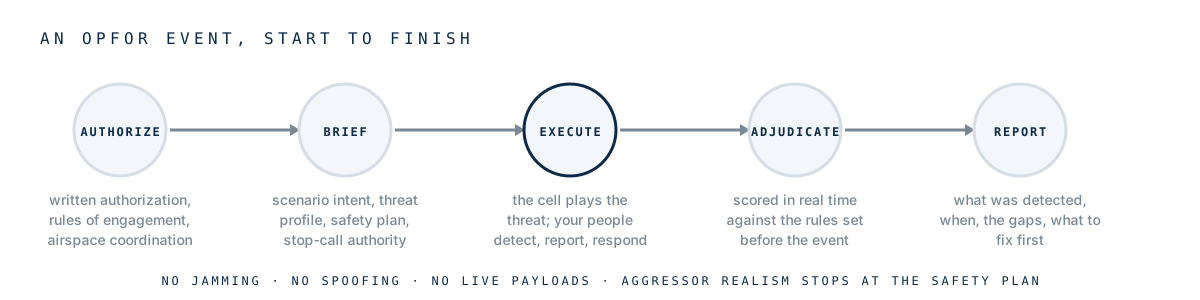
Authorize, brief, execute, adjudicate, report. The findings report is the deliverable.
Written authorization from the sponsoring commander or facility owner, published rules of engagement, airspace coordination and range safety control before any sortie.
A certified adversary cell with an adjudicator, and a safety officer who owns the stop call and does not instruct.
Threat profiles drawn from an open-source adversary study, graded for confidence.
A findings report: what was detected and when, where the gaps were, what to fix first.
Aggressor realism stops at the safety plan
The cell does not jam, does not spoof, does not transmit on the friendly control frequency, does not carry live payloads, and does not maneuver inside the separation set in the risk assessment. We are the adversary, the trainer and the assessor. We do not operate defeat systems; active mitigation remains the unit's function under the unit's authority. Every engagement runs under our Safety Management System and FAA Part 107.
Past work
Tennessee Maneuvers, Fall Creek Falls, May 2026. Two days of multi-agency unmanned-aircraft operations under coordination with TEMA, the Tennessee State Guard and the Tennessee Air National Guard, across a 1,600-acre assigned sector inside a 16,000-acre exercise area, with zero safety incidents and zero equipment losses under Part 107. After-action report on file; redacted copy available as a past-performance reference.
Authorized adversary counter-UAS evaluation, 2026. Conducted at a Tennessee facility under National Guard chain-of-command authorization. Details held and available to authorized parties through appropriate channels.
Who it is for
National Guard and state defense force units building organic SUAS and counter-UAS proficiency.
Installation, facility and critical-infrastructure security owners.
Law enforcement and emergency management teams preparing for drone threats at events and venues.
How it is bought
Each operation is a defined training event with a defined deliverable, priced firm-fixed per objective. The recommended entry point is a single pilot event within the federal micro-purchase threshold, followed by a Blanket Purchase Agreement for recurring events across the training year. Contracted adversary support is an established model the Marine Corps already buys. See government and defense contracting.